
SIMBA# – the simulation platform
Build models graphically from modules that match real-world objects. More than 20 libraries and 120 ready-made examples – from WWTPs to sewers and rivers, biogas, energy and control.
Your model as a flowsheet
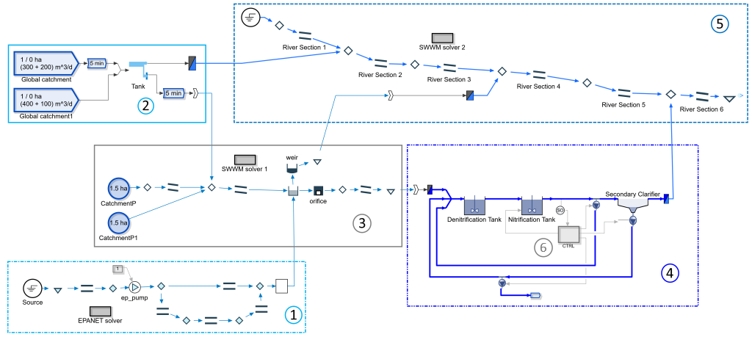
Every module represents a part of the system – a sewer section, primary clarifier, aeration tank, sludge line or controller. Connect modules into a flowsheet and SIMBA# simulates the whole system dynamically over time.
Thanks to the multisolver, sewers, treatment plants and rivers can be combined in a single model to assess how they interact.
SIMBA# in your browser
No installation and no registration: open the example WWTP, change block parameters and run a simulation. Double-click a block to open its parameters, click it to see its results.
The demo is designed for a computer with a larger screen.
Please note: the web demo is only a simplified illustration of working with SIMBA#. It calculates directly in the browser with a simplified model – results are indicative only and do not reflect the quality or scope of the full SIMBA# tool.
From detail to the whole system
Choose the right level of detail for each task – and combine different approaches in one model.
Treatment plants and activated sludge
Standard IWA models ASM1 and ASM3 and, for design, ASM3h and ASM3bioP in the HSG versions compatible with DWA-A 131 (2016). Blocks for aeration tanks, cascades, SBRs, primary and secondary clarifiers and sludge treatment – the activated sludge model is chosen independently of the reactor type.
Aeration systems
Blowers and their control, pipework with typical fittings, control valves and diffusers. Design more energy-efficient aeration and avoid common design errors.
Sewers and catchments
Hydrological (catchment runoff, storage and CSOs according to DWA-A 102 / A 128, long-term simulations) and hydrodynamic (Saint-Venant equations, SWMM5 import and solver). Both approaches can be combined in one network. Impervious areas can even be estimated from Copernicus satellite data.
Pressure networks and pumping
Drinking water networks, rising mains and pressure sewers with an EPANET-based solver – including pressure-dependent demand, leakage and substance transport. Detailed pumping station models.
Biogas and energy
Anaerobic processes based on ADM1, biogas plants, sludge treatment and WWTP energy balances – electricity and heat consumption and production.
Control and automation
Function blocks, PI(D) controllers, sequential control with Petri nets, user algorithms according to IEC 61131-3 (ST) and model-based predictive control (MBPC).
What you can model
Over 20 libraries for water, wastewater, energy and industry – all combinable in one flowsheet.
Activated sludge
ASM1, ASM3h (HSG), ASM3bioP and Anammox for sludge liquor. Pre-, intermittent and alternating denitrification, SBR, MBR, cascades, ditches and channels.
Biofilm processes
MBBR and IFAS, fixed bed, MABR (also anaerobic), aerobic granular sludge, UASB and trickling filters – with bulk, biofilm and gas phase.
Micropollutant removal
Ozonation with model calibration from batch tests and powdered activated carbon (PAC) with Freundlich isotherms fitted to lab data.
Sludge & biogas
ADM1-based digesters fed with silage and manure, biogas potential tests, digestion at WWTPs, gas storage and gas drying.
Aeration
Blowers, air pipes, valves with positioner models, diffusers and surface aerators, pure oxygen, pressure and air distribution control.
WWTP hydraulics
Dynamic hydraulic calculation of the whole plant: channels, weirs, Venturi flumes, screens, orifices and pumps.
Sewers & GIS
Hydrological networks according to DWA-A 102 and A 128, hydrodynamic networks, shapefiles and elevation models, automatic impervious areas and network simplification.
Rivers
River water quality with RWQM1 and SWQM, oxygen sag, pollutant transport and integrated sewer – WWTP – river models.
Drinking water & pumping
Water distribution networks with the EPANET solver, tanks, valves and pumps, and hybrid open channel / pressure pipe models of pumping stations.
Control & automation
PID and fuzzy controllers, Petri nets, model-based predictive control (SISO/MIMO), automatic sewer RTC generator, state observers and SCADA.
Energy systems
Energy check and analysis according to DWA-A 216, photovoltaics with weather data, heat pumps, CHP, batteries and energy management.
AI & neural networks
Feedforward, convolutional and recurrent networks (LSTM, GRU) built from Keras layers – e.g. for predicting effluent ammonium.
Over 120 example models included
Every installation comes with ready-to-run models you can open, simulate and adapt. A selection by topic:
12 examplesWastewater treatmentShow examples
- WWTP with ASM1, ASM3h (HSG) and ASM3bioP
- Alternating/intermittent aeration
- WWTP with sludge digestion
- Anammox for sludge liquor
- SBR with Petri net control, two coordinated reactors
- Cascade, ditch and long channel
- Animated reaction network
22 examplesAdvanced reactorsShow examples
- Gas phase (bubbles) in every reactor
- pH in sludge and biofilm
- Surface aeration with pure oxygen
- Horizontally and vertically discretised tanks
- MBR, SBR, UASB, MABR, MBBR, AGS
7 examplesBiofilmShow examples
- MBBR / IFAS and moving carrier
- Fixed bed (e.g. textile carriers)
- MABR, aerobic granular sludge
- Trickling filter
7 examplesAeration & micropollutantsShow examples
- Aeration system with blowers, valves and positioners
- Surface aeration
- Ozonation stage and model calibration
- WWTP with PAC stage, isotherm fitting
8 examplesBiogasShow examples
- Digester with original ADM1
- Silage and manure feed, dynamic feed and temperature
- Gas storage and gas drying
- Biogas potential tests (manure, silage)
11 examplesSewers & GISShow examples
- DWA-A 102 example network and event-based evaluation
- A 128: calibration, experimental design, Monte Carlo, throttle optimisation
- Hydrodynamic network with GIS and automatic impervious areas
- Simplification of a 400+ node network (Fehraltorf)
- Integrated sewer – WWTP – river model (Astlingen)
- Wastewater pumping station (SWMM + EPANET)
16 examplesControlShow examples
- WWTP control: return sludge, recirculation, aeration, ammonium
- PID and fuzzy control
- MBPC: SISO, MIMO 2×2, discrete manipulated variables
- Automatic RTC generator and MPC for sewer networks
- WWTP observer and predictor
- WWTP operated via SCADA
8 examplesRivers & drinking waterShow examples
- River water quality with RWQM1, SWQM and a DO sag model
- Pollutant transport (Lagrange vs. CSTR, meandering river)
- Water distribution networks (EPANET)
- Open channel + pressure pipe hybrid
6 examplesEnergyShow examples
- Energy check and energy analysis according to DWA-A 216
- House energy balance: PV, battery, heat pump, gas boiler
- Weather data from the German Weather Service (DWD)
11 examplesAIShow examples
- Feedforward network (FNN)
- Convolutional networks (CNN)
- Recurrent networks: SimpleRNN, LSTM, GRU
- WWTP models with AI prediction of effluent ammonium
9 examplesIndustry, supply & nexusShow examples
- Water audit of a factory (fresh, cooling and waste water)
- Process water and multi-source management
- Rainwater harvesting tank
- Water–energy–food nexus city model
- Shit Flow Diagrams
4 examplesScriptingShow examples
- C# scripts and multiple-choice wizard
- Lab experiment scripts (batch tests)
- BOD / OUR test evaluation
Built for engineering practice
- WWTP design and evaluation according to DWA-T4/2016 (EXPOPLAN tool) and DWA-A 131
- Influent characterisation for municipal WWTPs using the HSG-Sim method
- Real-time online operational support via ifakFAST (digital twins)
- Combined sewer, WWTP and river models for immission analysis
- GIS – georeferenced networks, shapefiles, bitmaps and digital elevation models
- Multiphase models for liquid and gas phases and biofilms
- Extended process matrix editor (Gujer)
- Result evaluation and a graphical scripting tool, scripts can also run via a web application
- Open model source code and a C# editor with code completion
- Calibration, experimental design and Monte Carlo simulation
- Automatic generation of sewer real-time control (RTC) and network simplification
- Petri nets for sequence control (e.g. SBR cycles)
- Neural networks (FNN, CNN, LSTM, GRU) directly in the flowsheet
Version history
An overview of the main changes in each SIMBA# version. Major upgrades bring extensive enhancements; feature and service updates add smaller features and fixes.
SIMBA# 7.5
Current version June 2026
- Wizard for automatic sewer real-time control (RTC) generation
- Wizard for automatic sewer model simplification
- Wizard for analysis of WWTP simulations
- Wizard for Life Cycle Costing and Assessment (LCC/LCA)
- Ozonation models
- Generic fuzzy control module
- Enhancements for multiphase reactors, WWTP hydraulics and AI-supported applications
SIMBA# 7.0
- New technical platform: .NET 10 and Avalonia UI
- Light and dark mode
- Linux and macOS support (installers in preparation)
- New SCADA library for running models in real time – operator training and support
- Animated reaction networks
- Optimisation and calibration assistants
- Reporting assistant
- Dynamic text displays linked to simulation results
- New Sankey diagram display options
- Code completion in C# editors
SIMBA# 6.0
- E-check library for energy analyses and audits according to DWA-A 216, incl. energy consumption and production models
- WWTP hydraulics library – stationary and dynamic calculation
- Dynampere library for simplified analysis of energy concepts (production, consumption, storage)
- AI integration – modelling, training and deployment of artificial neural networks
- Improved micropollutant removal models using powdered activated carbon
- Digital twins – online simulation linked to real plants
- New WWTP inflow model, improved water chemistry library and new optimisation interface
SIMBA# 2013
Technically independent SIMBA# platform aimed at everyday engineering practice.
SIMBA 1994
First release as a MATLAB/Simulink toolbox, used in research and practice worldwide.
Want to see SIMBA# in action?
Download the free demo – after a short form the download page opens. Or watch the video tutorials.